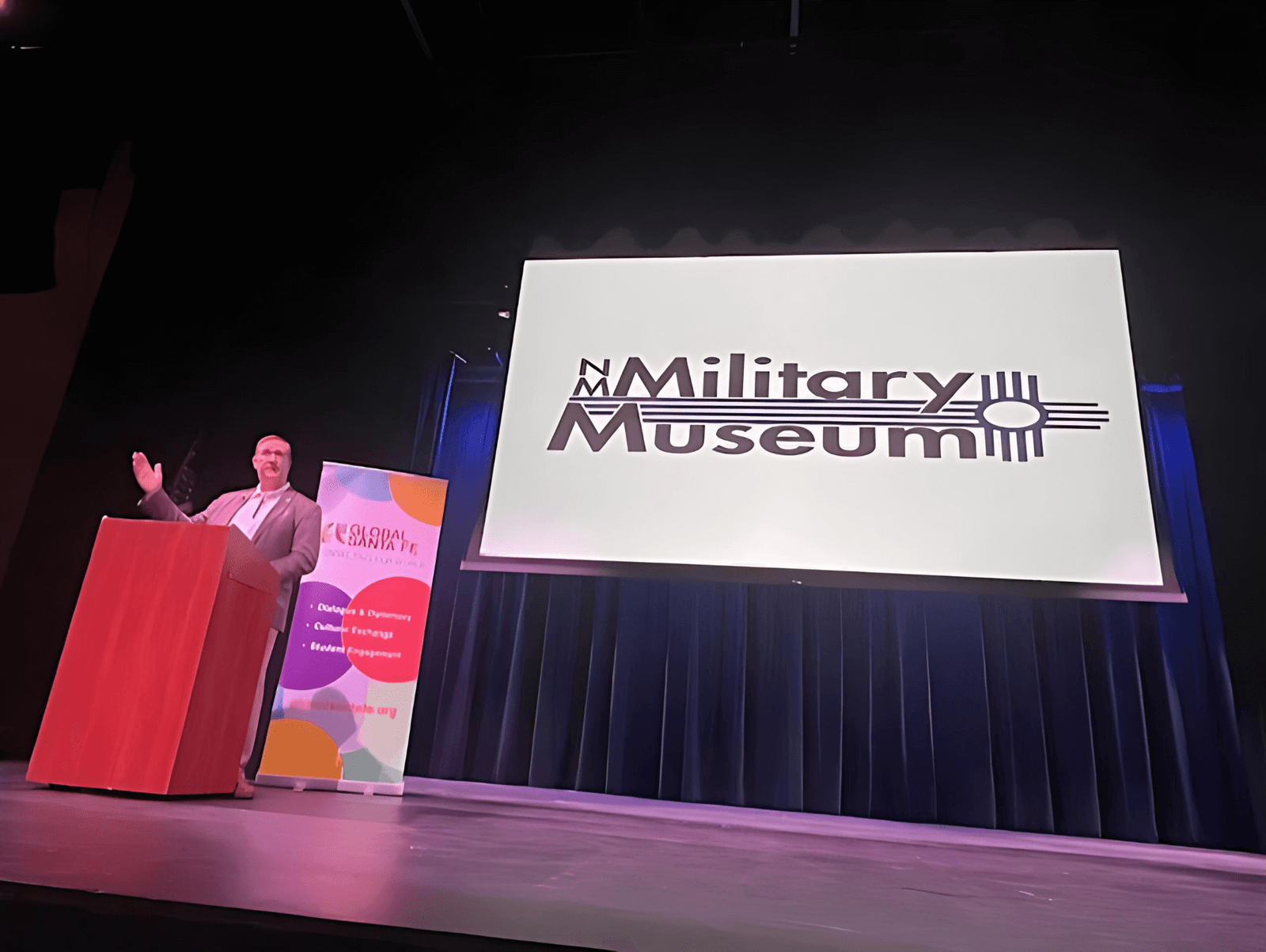
I am not an expert on how nuclear weapons actually work, because I’m not a nuclear physicist. I am in a room with people who actually do understand how nuclear weapons work.
What I’m going to talk about tonight is how the fact that nuclear weapons exist has affected international relations over the last 80 years. That’s my area of expertise.
I’m going to tell 80 years of history through four moments in time, with the context sketched around each. Those moments are:
- July 16, 1945: the Trinity test at Alamogordo, New Mexico, and especially what it meant to Harry Truman, thousands of miles away in Potsdam, Germany;
- June 10, 1963: President John F. Kennedy’s commencement address to American University;
- November 20, 1985: President Ronald Reagan’s first in-person meeting with Soviet leader Mikhail Gorbachev in Geneva, Switzerland; and
- April 5, 2009: President Barack Obama’s speech in Prague calling for the eventual abolition of nuclear weapons.
I’ll talk about the paper that I wrote for Stimson with my colleagues Geoff Wilson and Lucas Ruiz. I’m going to talk about how we got here, which is to say, “How did we survive 80 years with nuclear weapons and not blow up the planet?”
And I’ll close with a note on the importance of humility. We can speculate on what effect nuclear weapons have had, but it’s hard — or even impossible — to know for certain.
July 16, 1945
So, July 16, 1945. We all know what happened, here in New Mexico, on that date. The aftereffects are still being felt to this day.
But, Harry Truman was not in New Mexico. Truman was in Potsdam, outside of Berlin in Germany. And the impact of the Trinity test on U.S. policy in the war — and U.S. post-war foreign policy, too — was immediate. Upon hearing the news that the test was successful, Truman’s attitude toward the war and what would come after changed.
He was first made aware of the nuclear weapon program on April 13, 1945, the day after he assumed the office of the presidency, following the death of Franklin Delano Roosevelt. Truman didn’t know anything about the Manhattan Project before then. But upon learning more about the program a few weeks later, Truman concluded that, if this thing actually worked, it would have an enormous impact on the course of the war. On June 1, 1945, he directed that the weapon be used against Japan to help end the war.
And, thus, we look at the bombing of Hiroshima on August 6, 1945, as the last act of World War II.
Except, of course, that it wasn’t the last act of World War II. Keeping to the promise that Soviet leader Joseph Stalin made to Franklin Roosevelt at Yalta, and reaffirmed to Truman at Potsdam, the Soviets entered the war against Japan on August 8, 1945. Then followed the bombing of Nagasaki on August 9 — again as planned. And only then did Emperor Hirohito announce on August 12 Japan’s acceptance of the Potsdam Declaration, which had spelled out the terms of surrender that the United States and Britain (the Soviets didn’t sign) sought, and would accept.
I find the debate about the impact of the weapons — both the Hiroshima and Nagasaki bombs — on the end of the war to be fascinating. For most of my life, I thought of those bombings, those two incidents together, as being both the last moment of World War II and the first moment of the Cold War, my area of expertise.
But I’ve changed my mind. In their book, The Atomic Bomb and the Origins of the Cold War, historians Campbell Craig and Sergey Radchenko make a convincing case that, in fact, the Hiroshima bomb was the last act of World War II, while the Nagasaki bomb was the first act of the Cold War.
Here’s why. Truman believed that he needed the Hiroshima bomb to obtain Japan’s surrender, to avoid having to send U.S. forces ashore on the Japanese home islands. He always wanted that surrender. But after July 16, after he learned of the Trinity test, he wanted a quick surrender.
Had Truman not been concerned about what impact the Russians’ entry into the war would have on their place in the international order, he might have let things play out. After all, the leaders of Japan did not have much time to contemplate their situation between the dropping of the first atomic bomb on the 6th and the dropping of the second bomb on the 9th. But, after August 9, U.S. officials quietly dropped the insistence that the Japanese remove the emperor. Had it been a truly unconditional surrender, the Japanese might have held out longer. But once it was clear that the emperor could remain, that convinced the Japanese to surrender.
At that critical moment, the United States was the only country on Earth with an atomic bomb in hand. Truman wanted to limit Stalin’s leverage, leverage that the Soviet leader would obtain by seizing more territory, in Manchuria and perhaps even in Japan, by force. The atomic bomb monopoly gave the United States the upper hand.
To be sure, there was some talk about international control. People suggested that this kind of power should not be held by just one country. Some of the Manhattan Project scientists felt that way. Another leading advocate was Henry Stimson, the Secretary of War.
But international control never got off the ground. A key reason why, Craig and Radchenko explain, is that by early 1943, Stalin already had a bomb program. FDR, Truman, and other U.S. officials might have known about this, but all Americans knew about the Soviets’ interest in obtaining an atomic bomb following revelations of espionage that came out in late 1945 and then early 1946. Once those stories were in the open, it became even harder politically for Truman to make the case for international control. At a time when the United States had a weapon, and the Soviet Union did not yet have one but was presumably racing toward one, international control would have required Truman to sell the idea that, after all the money and effort that had gone into creating this weapon, it was all going to be given away, on Stalin’s promise that he wouldn’t develop a bomb and keep it.
To repeat, Truman treated the Hiroshima bomb as a military weapon, and he acted as though he would use subsequent weapons in the same way. The United States would wield its atomic monopoly for as long as it could. It would not be handed over to others.
And yet, we know that Truman did not think of it strictly as a military weapon. In a meeting with David Lilienthal, the Atomic Energy Commission chairman, on July 21, 1948, Truman said, “This isn’t a military weapon. It is used to wipe out women and children and unarmed people, and not for military uses. So we have got to treat this thing differently from rifles and cannons and ordinary things like that.”
In his book The Bomb, Fred Kaplan writes, “Much of the history of the bomb over the subsequent seventy [now eighty] years … is the story of the generals and many civilian strategists trying to make it a ‘military weapon’ after all.”
That’s a story worth exploring.
June 10, 1963
The next important moment in the history of nuclear weapons is John F. Kennedy’s American University commencement speech on June 10, 1963.
In the speech, Kennedy spoke eloquently of the search for peace. “Not the peace of the grave or the security of the slave,” he said, but rather “genuine peace, the kind of peace that makes life on earth worth living.” And “not merely peace for Americans but peace for all men and women — not merely peace in our time but peace for all time.”
He linked peace to the vast nuclear enterprise that he presided over — and had helped to expand. “Today, the expenditure of billions of dollars every year on weapons acquired for the purpose of making sure we never need to use them is essential to keeping the peace,” Kennedy explained. “But surely,” he went on, “the acquisition of such idle stockpiles — which can only destroy and never create — is not the only, much less the most efficient, means of assuring peace.”
He recognized that many would doubt his calls to rein in nuclear weapons in the search for peace, calling such efforts “useless until the leaders of the Soviet Union adopt a more enlightened attitude.” But while expressing hope for such an outcome, Kennedy turned the focus on the American public, calling on Americans to “reexamine our own attitude — as individuals and as a Nation.”
The United States and the USSR, he said, had a “mutually deep interest in a just and genuine peace and in halting the arms race.” To that end, Kennedy pointed to ongoing talks in Geneva, focused on “arms control designed to limit the intensity of the arms race and to reduce the risks of accidental war.” He announced the establishment of reliable communication channels between Washington and Moscow to reduce the risks of miscalculation during crises. And he affirmed that the ultimate object was “general and complete disarmament — designed to take place by stages, permitting parallel political developments to build the new institutions of peace which would take the place of arms.”
This was a dramatic departure for Kennedy, who had built his political reputation by criticizing people like his predecessor, Dwight Eisenhower, for not taking the Cold War seriously enough. First there was a “bomber gap,” where supposedly the Soviets had built many more bombers much faster than the United States had. And then there was a “missile gap.” When the Soviet Union launched the Sputnik satellite on October 4, 1957, many Americans became convinced that the Soviets must be on the cusp — or might already have — the ability to deliver an intercontinental ballistic missile (ICBM) from Soviet territory onto the United States.
Kennedy’s successful campaign in 1960 was built on a promise of heavy investment in nuclear weapons and nuclear weapons technology. When he became president, he learned that there was no missile gap — or, more accurately, that it favored the United States.
But two key crises — in Berlin in 1961, and then the Cuban missile crisis in October 1962 — caused him to reconsider some of his core beliefs about nuclear weapons and nuclear threats.
First, some background. By 1962, the United States had three different ways to deliver nuclear weapons against the Soviet Union. The original way, as with Hiroshima and Nagasaki, was bombs dropped by aircraft. By the mid-1950s, the United States had long-range bombers that could reach the Soviet Union. The United States then developed rockets and by 1959 had ICBMs, also capable of hitting the Soviet Union. Then, starting in late 1960, the United States added the Polaris missile, launched from submarines (aka SLBMs).
This is what we now know as the triad. Three different ways to deliver nuclear weapons — from bombers, land-based ICBMs, and from submarines. And the United States had all of these on the day that Kennedy assumed the presidency. At the time of the Cuban Missile Crisis, by contrast, the Soviet Union had four to six ICBMs.
The Cuban Missile Crisis was Soviet leader Nikita Khrushchev’s attempt to alter that imbalance. By placing missiles in Cuba — missiles that were capable of reaching New York and Washington and other major cities in the United States — the Soviets had temporarily leveled the playing field, or at least leveled it enough. After the crisis, Kennedy allowed that he would have been deterred from taking action against the Soviet Union by “what they had in Cuba alone” — about two dozen missiles, notes Fred Kaplan.
As for the way that the US-Soviet standoff played out, Kennedy and others in his administration hid key details. Americans at the time were convinced that the Soviets capitulated in the face of sheer toughness and resolve. Secretary of State Dean Rusk’s quip that the two had gone “eyeball to eyeball,” and the Soviets “just blinked” survived as the bumper-sticker summary. According to this version of the story, the Kennedy administration made no concessions.
But that wasn’t true. We now know that, in exchange for the Soviets removing missiles from Cuba and promising never to place them there again, the United States promised never to invade Cuba and to remove the 15 Jupiter intermediate-range ballistic missiles located in Turkey.
This deal was hidden for many years — with pernicious effects. In his 1988 memoir, Kennedy’s national security advisor, McGeorge Bundy, lamented how, by concealing the truth about the missile trade, he and others in the administration had “misled our colleagues, our countrymen, our successors, and our allies” into believing “that it had been sufficient to stand firm.” According to Les Gelb, a Pentagon official in Lyndon Johnson’s administration who went on to lead the Council on Foreign Relations, “the myth of the missile crisis” had distorted U.S. foreign policy for 50 years by celebrating “threats and confrontation” and discouraging “realistic compromise.”
The bottom line is this: by June of 1963, Kennedy — like Truman before him — had come to doubt the utility of these weapons. He especially doubted the need to engage in an arms race. Hence, the speech at American University, which set the stage, at a minimum, for the limited test ban treaty, signed in August of 1963, and then the nuclear non-proliferation treaty (NPT), which was opened for signatories in 1968 and went into force in 1970.
Today, the permanent five members of the United Nations Security Council have nuclear weapons, as they all did in 1968. Just four other countries — India, Israel, North Korea, and Pakistan — have gone nuclear. A few others had nuclear weapons programs and gave them up. But the vast majority of states have forgone nukes completely. And indeed, 94 have signed the Treaty on the Prohibition of Nuclear Weapons. If you had told U.S. officials in the mid-1960s, who were very concerned about the rampant proliferation of nuclear weapons, that, by 2025, there would only be nine nuclear weapon states, I think they would have been pleasantly surprised.
November 20, 1985
Alright, racing ahead. November 20th, 1985. Ronald Reagan is at the close of a two-day summit with Mikhail Gorbachev, the first time the two men had met in person. And that is when Reagan said, “A nuclear war cannot be won and must never be fought.”
This was a dramatic departure for Reagan. He was a cold warrior, and proudly so. He hated the détente — the relaxation of tensions with the Soviets — of the mid-1970s. He questioned why the United States would seek ways to reduce, or at least control the growth of, its nuclear arsenal. He was convinced that the Soviets were cheating, and would cheat, and thus obtain some strategic advantage. Other opponents of détente populated key positions in Reagan’s administration when he took office in 1981.
When asked about his strategy for the Cold War, Reagan replied, “We win, they lose.”
By 1983, the Cold War was perhaps as tense as it had ever been. In March 1983, Reagan called the Soviet Union “the evil empire” and “the focus of evil in the modern world.” Later that year, the Soviets seemed to prove his case when the Korean airliner KAL 007 was shot down over Russian territory on September 1, 1983, killing all 269 onboard, including a U.S. congressman.
Then, on November 20, 1983, ABC aired the made-for-television movie “The Day After.” More than 100 million people watched the film, which portrayed the effects of a nuclear exchange between the Soviet Union and the United States. But the phenomenon of “The Day After” went well beyond the airing of the film, to include on-air panel discussions as well as in-person meetings around the country.
Reagan had watched the film about a month before it was released. He was horrified by it, but he recorded in his diary that it only reaffirmed his determination to deter a conflict with the Soviet Union. And, as far as he was concerned, that’s exactly what he was doing with the buildup that he had championed.
But another incident occurred between the time that Reagan saw “The Day After” and when the rest of the American people did. Able Archer, a major NATO exercise in Europe, took place from November 7 to November 11, 1983. On several occasions during this exercise, some Soviet observers became convinced that this was it — NATO was preparing to attack. This was the time when the United States was actually going to carry out Reagan’s vision of “We win, they lose.”
To be sure, some in the U.S. government doubted that the Soviets had really been so fearful. Years later, however, the President’s Foreign Intelligence Advisory Board concluded that some in the Soviet Union “were genuinely worried by Able Archer” and that “at least some Soviet forces … were preparing to preempt or counterattack.”
Reagan was not privy to that later assessment. And he was likely inclined to the view that the Soviets wanted people to believe that they were afraid. If the tension was entirely created by the United States, pressure would build on the United States to back down.
And yet, we know that a week after the exercise, Reagan asked Secretary of State George Shultz to figure out a way to establish a back channel with Moscow. Reagan noted in his diary that the Soviets “are so paranoid about being attacked that without being in any way soft on them we ought to tell them no one here has any intention of doing anything like that.”
Well, re-establishing stable communication wasn’t easy. He would later explain that he had been unable to meet with Soviet leaders because “they kept dying on me.”
He wasn’t wrong. Leonid Brezhnev died in November 1982. Yuri Andropov died in February 1984. And then Konstantin Chernenko died in March 1985. It’s hard to establish a dialogue under such circumstances. Plus, Soviet leaders were not in great health, even when they were still alive, so it wouldn’t have made for a very good conversation.
With Mikhail Gorbachev, things were different. He and Reagan initiated a series of meetings, starting in Geneva in November 1985, followed by the Reykjavik summit in October 1986, and then meetings in the United States in 1987 and Moscow in 1988. The pattern of dialogue, with the aim of controlling the arms race, continued under Reagan’s successor, George H.W. Bush, and produced the intermediate-range nuclear forces (INF) agreement pertaining to Europe and START, the first of the strategic arms reduction treaties.
Then the Cold War ended. I guess Reagan was right? We won, they lost. The nuclear arsenals on both sides fell precipitously. And yet neither side gave up on nuclear weapons.
April 5, 2009
Which brings us closer to the present day — April 5, 2009. That’s when President Barack Obama said, in a speech in Prague’s Hradcany Square, “the United States will take concrete steps toward a world without nuclear weapons,” while also noting that “as long as these weapons exist, the United States would maintain a safe, secure, and effective arsenal to deter any adversary and guarantee that defense to our allies.”
Remember, that was one of the commitments that the nuclear weapons states made under the nuclear nonproliferation treaty: in exchange for countries signing the NPT and agreeing not to develop nuclear weapons of their own, they were entitled to peaceful uses of nuclear energy. The nuclear weapons states, for their parts, agreed to reduce the role of nuclear weapons and ultimately to move towards their elimination.
This speech in Prague didn’t come out of nowhere. Obama’s undergraduate thesis at Columbia was about nuclear disarmament. But he may have been emboldened when, on January 4, 2007, Henry Kissinger, Sam Nunn, William Perry, and George Shultz — four grand poobahs of U.S. national security strategy — wrote an article in the Wall Street Journal talking about a world free of nuclear weapons.
The four men were concerned that the world was on the cusp of a new arms race, with new nuclear weapons states poised to join the club. This wasn’t the comfortable bipolarity of the United States and the Soviet Union; these new nuclear weapons states increased the risk, they wrote, of nuclear weapons being used. So, Kissinger, Nunn, Perry, and Shultz invoked the example of the Reykjavik meeting between Reagan and Gorbachev, and called for a new round of arms control talks.
When he was running for president, Obama spoke of the importance of recommitting to reducing nuclear weapons. After he was elected, he negotiated with then-Russian President Dmitri Medvedev to cap the number of warheads and delivery vehicles on both sides. They signed the New START agreement on April 8, 2010.
But in order to secure ratification in the Senate for the New START treaty, Obama had to placate Republicans. That meant convincing Senator Jon Kyl of Arizona, the minority whip, not to block a vote. Obama proposed $80 billion over 10 years for the nuclear weapons complex, $10 billion more than George Bush’s last budget over the same time period. Obama also promised to spend $100 billion to modernize all three legs of the triad — bombers, land-based ICBMs, and submarine-launched missiles. In the ensuing negotiations with Kyl to secure the necessary GOP votes, Obama added another $5.5 billion over 10 years for the nuclear complex. It worked. The lame-duck Senate approved New START by a vote of 71-26 on December 22, 2010.
But Obama did not make any more progress on reducing the role of nuclear weapons. He had his national security team calculate what was actually necessary for deterrence — and ultimately concluded that it wasn’t worth the political hassle to try.
So, instead, he sent out Vice President Joe Biden to put a pleasing spin on his administration’s approach to nuclear weapons. In January 2017, after Donald Trump had won the 2016 election, Biden said:
Given our non-nuclear capabilities and the nature of today’s threats, it’s hard to envision a plausible scenario in which the first use of nuclear weapons by the United States would be necessary or make sense …. President Obama and I are confident we can deter and defend ourselves and our allies against non-nuclear threats through other means.
And then he closed with a line that had never been said before publicly, at least not this categorically, by a senior U.S. official since the dawn of the atomic age: “Deterring and, if necessary, retaliating against a nuclear attack should be the sole purpose of the U.S. nuclear arsenal.”
It didn’t quite work out that way, as we discuss in our recent Stimson paper.
The triad modernization — the deal that Obama cut with Senator Kyl — was supposed to cost $100 billion over ten years. Now, it’s projected to cost at least $1.7 trillion over 30 years; most estimates now put it closer to $2 trillion.
Some of this is waste and mismanagement. The Sentinel ICBM program is a particularly egregious case: 81% over budget, and many years behind schedule. So much so that the Minuteman missiles that the Sentinel was supposed to replace — the missiles that the advocates for the new ICBM swore could not possibly be extended any longer — may remain in service for years.
But the true driver of the current nuclear expansion is the belief that more weapons are needed to deter both China and Russia, and that new types of nuclear weapons are needed to credibly threaten a first strike. In our paper, we make the case for strict deterrence: that is, a focus on deterring attacks against the United States, and therefore only in retaliation, consistent with what Vice President Biden said in January 2017.
There are several explanations for why the United States has not moved in the direction that Presidents Kennedy, Reagan, and Obama hoped we would in terms of reducing the role of nuclear weapons in U.S. national security strategy. I think there is one particularly salient reason why U.S. officials have not succeeded, at least not since New START in 2010, in reducing the number of nuclear weapons — in other words, in a direction consistent with our commitments under the nuclear nonproliferation treaty. The reason why we haven’t done so may be … nuclear nonproliferation.
You heard that right. Over and over again, when people have made the case for a minimal deterrent — a deterrent focused on retaliation first and foremost, or for nuclear weapons to be used solely in response to a nuclear attack — others have expressed concern that this would send a bad message to U.S. allies, some of whom have chosen not to develop nuclear weapons, at least in part because they are covered by the U.S. nuclear umbrella (aka extended deterrent). Some of those allies, if they came to doubt the U.S. commitment to them, might be tempted to develop weapons of their own.
After all, how credible is it, they ask, that the United States would trade New York for Paris? How do we make that threat credible? How do we make allies believe that we will have their back? That we will respond to an attack on them as though it were an attack on us, even if that means that we will subsequently be attacked?
The way you make that credible, the argument goes, is with a first strike. A force that is capable of striking the other side before they strike you. Damage limitation. That’s the term they use. That’s the logic of it. Now, we don’t engage with that much in this paper. We think it’s wrong. We worry that new methods for trying to affirm U.S. credibility — things like low-yield weapons or more first-strike weapons — may move us closer to nuclear use. We doubt that U.S. extended deterrence is the critical factor — and certainly not the only one — explaining why so many U.S. allies have chosen never to develop them. And we believe there are other ways to advance the cause of nuclear nonproliferation without having to commit the United States to a nuclear arms race. But it is an important debate to have.
I want to close with where I started: on humility. And here we are, thankfully, 80 years after Nagasaki: no nuclear weapon has been detonated as an act of war. And I think if you had said to the scientists at Los Alamos, or to Harry Truman, or to all of the various folks who worried about nuclear weapons in the late 1940s, 1950s, and 1960s, that we had made it this long without nuclear weapons having been detonated, I think they would say, “great!” They wouldn’t have been so confident — in light of what they knew, and what they feared — that that would have been the case.
It’s not accurate to say that nuclear weapons have not been used just because they haven’t been detonated. Nuclear weapons have been wielded, much in the way that a handgun is used in a stick-up; states in possession of nuclear weapons have threatened to use them to coerce others. And they have threatened to use them in retaliation, to deter. And so, as we think about nuclear weapons and the impact they have had on international relations for 80 years, we should appreciate that understanding whether or not those threats are material to our security is really important — and also really hard to know. And maybe we’ll never know.
But we should never stop trying to understand, in order to prevent that thing that we fear the most – a nuclear war, where no one wins.
Thanks to Alessandro Perri, an intern with the Reimagining US Grand Strategy Program, for his help on this essay.