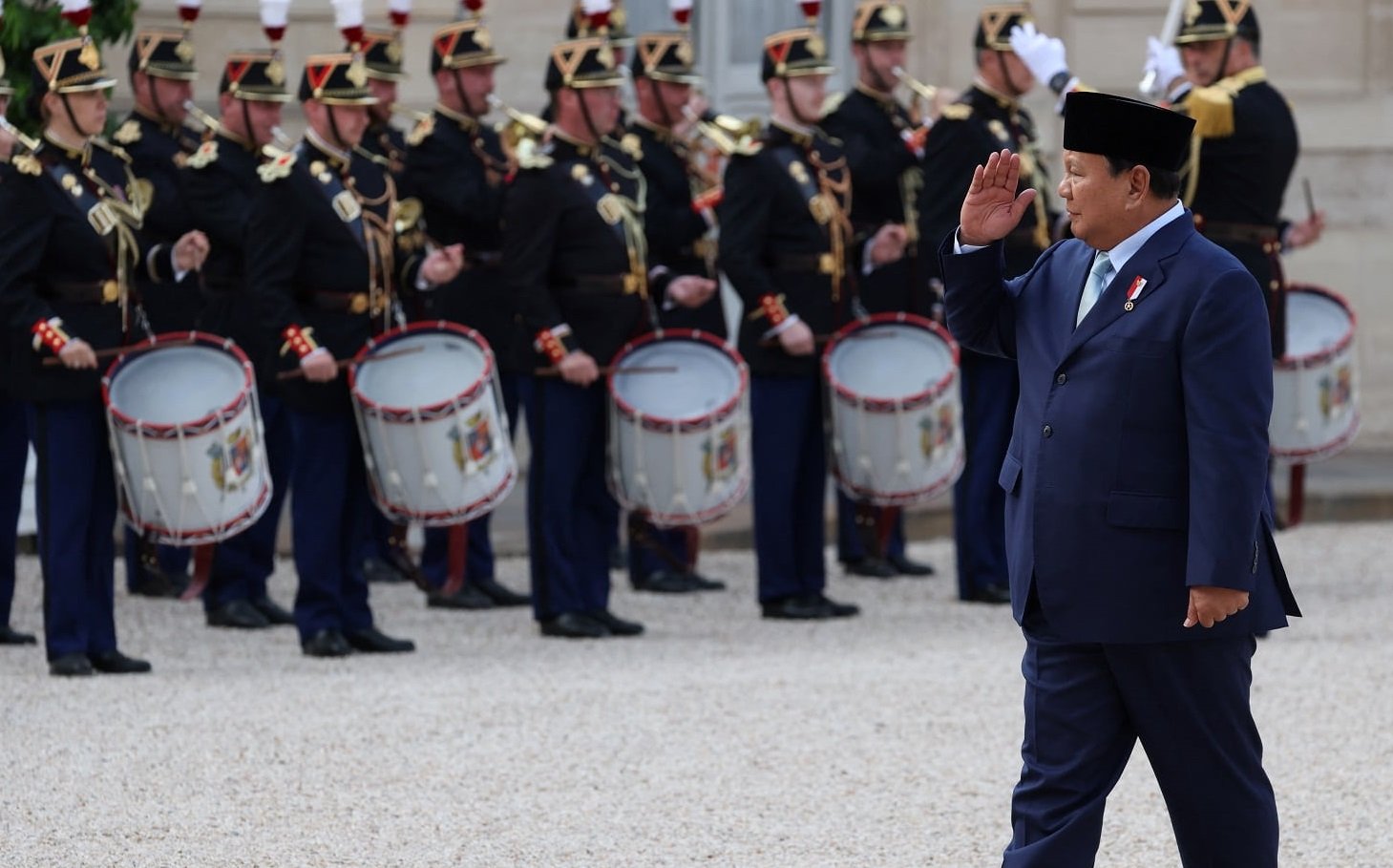
On 15 July, Belarusian President Alexander Lukashenko found himself with an unexpected house guest: Prabowo Subianto, President of Indonesia. The evening before, Prabowo had abruptly cancelled a planned Bastille Day dinner in Paris with representatives of major French weapons companies, citing a lack of new contracts to discuss. His drop-in to Belarus was so unplanned that no formal reception was held for him in any official building. Instead, Prabowo and Lukashenko spoke for three hours in the unusual setting of Lukashenko’s home, after which Prabowo returned immediately to Indonesia.
The rapid expansion of Belarus’s military ties in Asia has largely gone unnoticed.
A report from IntelligenceOnline suggested that the Indonesian leader’s eagerness to meet with Lukashenko may have been to discuss weapons purchases from Belarus, after failing to get what he wanted from the French. Two weeks later, Indonesia’s defence minister arrived in Minsk for negotiations on deepening military cooperation.
Indonesia pursues a policy of strategic autonomy in its defence relationships, balancing multiple partners including France, which has committed to selling Indonesia at least 64 Rafale fighters. Prabowo’s choice of alternative destination after apparently being stymied in further military acquisitions from France on Bastille Day was no coincidence. While Australia’s attention has been fixed on the military relationship between Russia and Indonesia, the rapid expansion of Belarus’s military ties in Asia has largely gone unnoticed.
In December 2024, Belarusian and Indonesian military officials met on the sidelines of a weapons exhibition in Vietnam to discuss potential joint projects. On 12 March 2025, Indonesia signed a military cooperation agreement with Belarus on unmanned aerial vehicle development, Sukhoi fighter aircraft maintenance, production of missiles and ammunition, and training of Indonesian Special Forces soldiers in Belarus. Belarus recently offered similar military and drone pilot training and aircraft maintenance deals to Russia’s allies in Libya and Mali.

In June, a Belarusian delegation attended the Indo Defence Expo in Jakarta where they presented a variant on the Buk-MB2K missile system marketed towards Asian countries still using Soviet-era launchers. A week later, an Indonesian Marine Corps commander publicly coveted the Belarusian MAZ-5362H5 vehicle specifically adapted to suit Indonesia’s environment. The outcome of Prabowo’s visit and the defence minister’s trip in July remain to be seen. Prabowo has also invited Lukashenko to visit Jakarta.
Beyond Indonesia, since the beginning of 2025 Belarus has also signed a strategic partnership including military and military–industrial cooperation and training with Vietnam; struck a military cooperation agreement with Pakistan; discussed military education and cooperation with India; and deepened ties with Myanmar including equipping and training the military junta’s forces. Belarus is also making diplomatic inroads across the region, stepping up engagement in recent months with Sri Lanka, Thailand and Laos.
Belarus’s diplomatic push into Asia comes in the context of a broader strategy by the Lukashenko regime since 2023 to deepen and diversify relations in what it calls the “distant direction” or “far arc”, including the Middle East, Africa, South America and Asia. While Belarus has not been hit quite as hard as Russia by sanctions over the invasion of Ukraine, there is nonetheless a need to develop new trading relationships with non-Western countries that are less concerned about Western sanctions.
The expansion of Belarusian military technology and influence is the expansion of Russian influence by proxy.
Drones and anti-drone technology form a cornerstone of Belarus’s military offering to prospective partners. In recent months, Lukashenko has been pushing to build up Belarus’s military drone production industry for export. There is no doubt that this is partly driven by Belarus’s own interests. At the same time, however, Belarus’s efforts to produce and export the technology must be interpreted in the broader geopolitical context.
Belarus’s drone industry and military supply chain are inextricably intertwined with Russia and, more recently, also with China and Iran. Since at least 2023, it has been rumoured that Belarus and Iran were in discussions to create a Shahed drone manufacturing facility in Belarus, primarily to service Russia’s needs for its war in Ukraine.
On 12 March (the same day Indonesia’s military cooperation agreement with Belarus was signed), Belarus and Iran signed an agreement for joint military–industrial development. The following day in a press conference alongside Russian President Vladimir Putin, Lukashenko announced that Putin had approved plans for a joint Russian–Belarusian production facility in Belarus with capacity to produce 100,000 drones per year.
The specific model has not been publicly confirmed, but it seems highly plausible that they intend to manufacture some variant of the Iranian Shaheds, which Russia is currently sending against Ukraine in huge volumes. Key components will almost certainly be sourced from China, which has been deepening its economic, diplomatic and military ties with Belarus. China is currently the main source of critical drone components for Russia’s own drone production.
Belarus, of course, can and does act on its own interests, but few would argue that it is a completely independent player on the world stage. The expansion of Belarusian military technology and influence is the expansion of Russian influence by proxy.
While it may not be as worrying as Russian military jets based on Biak, Prabowo’s spontaneous drop-in to Lukashenko’s home after cancelling on the French military producers is nonetheless significant. The nexus of the Russian, Chinese and Iranian military–industrial complexes coming together in Belarus, and then potentially being exported into our region, is something we should be paying attention to. Minsk’s manoeuvring should not continue to fly under Australia’s radar.