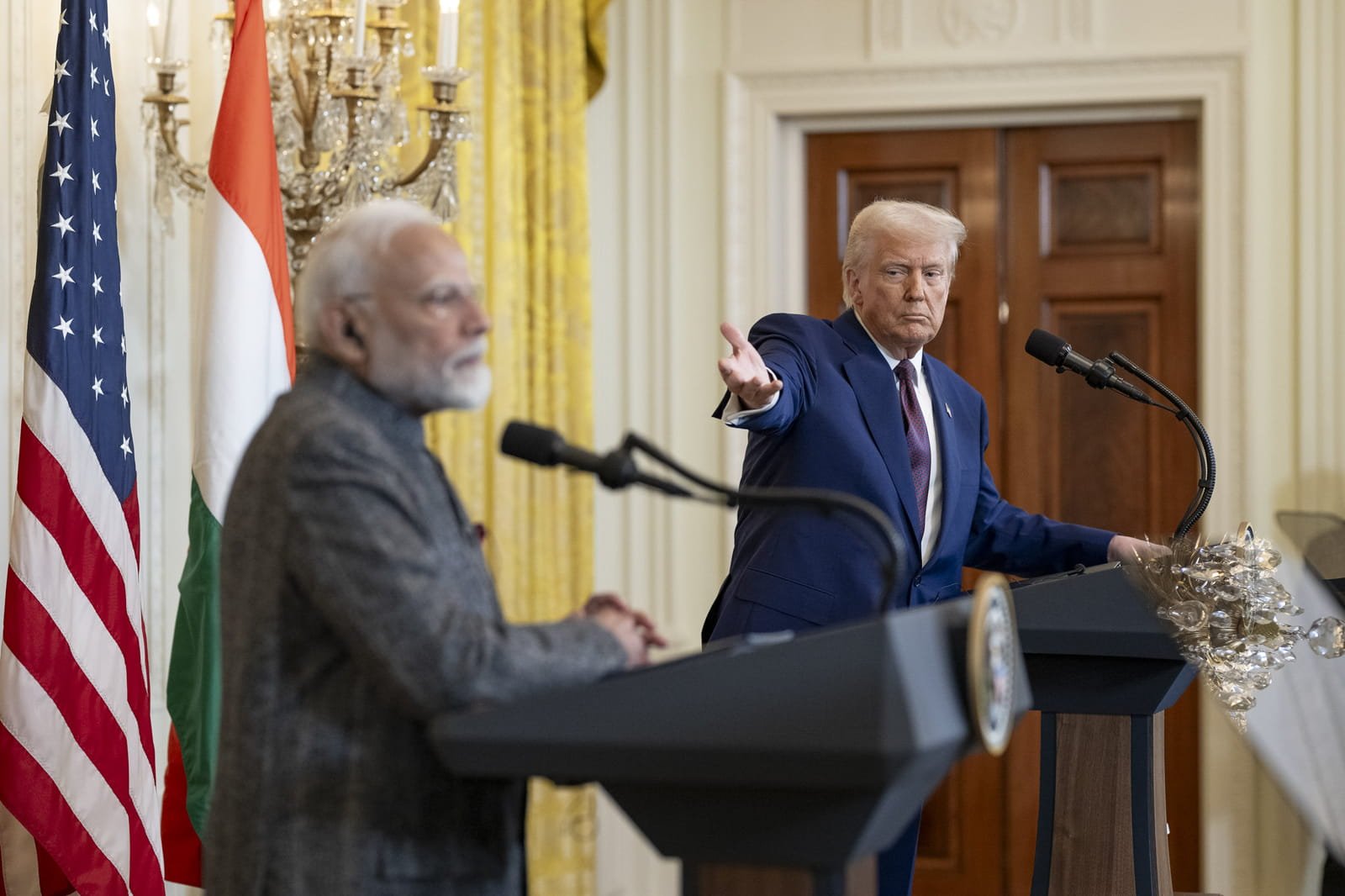
When US President Donald Trump was sworn in for his second term in January, India was among the most positive countries about the outlook for relations with the United States. Prime Minister Narendra Modi was the fourth world leader to visit Washington following Trump’s inauguration. A day after the inauguration, Indian External Affairs Minister Subrahmanyam Jaishankar met US Secretary of State Marco Rubio as part of the Quad foreign ministers meeting, and India is also set to host the Quad Summit for the first time later this year when Trump is scheduled to visit India.
Fuelling this optimism is the high degree of bipartisan consensus in Washington on deepening the bilateral relationship. There was also a belief that the Modi and Trump’s worldviews were aligned. Both are strongman populist leaders who regard China and radical Islam as existential threats, and share a common mistrust of the liberal media and civil society. The two are also economic nationalists at heart. One could even argue that India was Trumpian before Trump given India’s protectionist tendencies and transactional foreign policy. Moreover, India was in the unique position of being neither a US ally or adversary, so it didn’t face Trump’s wrath of not pulling its weight (like NATO members) or being seen to pose an existential threat to the United States (like China).
Developments this week demonstrate a degree of irrational exuberance in New Delhi’s expectations of the India-US relationship.
Trump’s announcement of 25% tariffs on India and his acerbic statements – of India as a “dead economy” that does “very little business” with the US with “the most strenuous and obnoxious non-monetary Trade Barriers of any country” – are likely to be bluster as the US seeks to extract concessions from India in order to secure a favourable trade deal. Trump’s social media statements do not equate to official government policy.
Nonetheless, this is a wake-up call for New Delhi, particularly when seen in the context of other recent actions by the Trump administration.
Just as Trump abandoned the United States’ more conciliatory approach towards China in his first term, this may be the beginnings of similar scrutiny of US engagement with India.
Amid efforts to secure a ceasefire in Ukraine, Trump has also threatened secondary tariffs on India for its trade with Russia. New Delhi is a leading buyer of Russian crude and more than 50% of India’s in-service military platforms are of Russian origin. He has also threatened 200% tariffs on pharmaceutical imports – which holds significance for India as a leading supplier of generic drugs to the United States – and 10% tariffs on BRICS member states for pursuing so-called “anti-American” policies. Washington has also announced sanctions on several Indian entities and individuals for trading with Iran.
Further souring relations with the United States is Trump’s position on recent India-Pakistan hostilities where he claims that he helped to broker the ceasefire between both countries in May (denied by New Delhi) while deepening relations with Islamabad (by hosting Pakistan’s Army Chief Asim Munir at the White House in June and pursuing resource and cryptocurrency deals with the country). Trump’s announcement of a trade deal with Pakistan on the same day as he announced tariffs on India has added insult to injury.
New Delhi had appeared relatively sanguine about Trump’s return. The announcement of Trump’s “reciprocal” tariffs in April was met with cautious optimism in New Delhi amid a belief that this would facilitate a degree of trade diversion away from China and other countries (in South and Southeast Asia) whose supply-chains are heavily exposed to China. India’s Commerce Minister Piyush Goyal referred to Trump’s tariffs as the “opportunity of a lifetime”. Vindicating this view, Apple announced that it was shifting production of its US market iPhones from China to India.
New Delhi remained positive amid expectations that India would be among the first countries to secure a trade deal with the United States. There was also a view among some in New Delhi that Trump’s tariffs could be a blessing in disguise by acting as a catalyst to accelerate India’s much-needed economic reform agenda, just as previous external shocks – from India’s 1991 balance of payments crisis to economic sanctions following India’s nuclear tests in 1998 – triggered the country’s first-generation reforms.
Now the mood has shifted. New Delhi fears that Washington could seek to “do a deal” with China. Despite the deepening India-US relationship over the last three decades, there has always been an underlying fear of strategic abandonment in both countries. Trump’s latest outburst will not change the direction of travel in the India-US relationship overall – that of a cautious embrace. But the shine has undoubtedly come off.
Even if a trade deal is secured, New Delhi can no longer rely on claims of the US as a “natural ally” amid an ideological affinity between the world’s oldest and largest democracy. Just as Trump abandoned the United States’ more conciliatory approach towards China in his first term, this may be the beginnings of similar scrutiny of US engagement with India. Washington may increasingly question why the US has stuck its neck out for India time and time again – from a civil nuclear agreement to supporting India’s G20 presidency and candidacy for a permanent seat on the UN Security Council – while India maintains close relations with countries with which the United States (and West) have a history of difficult relations, including Russia and Iran.
Ironically, this scrutiny may create a self-fulfilling prophecy as Trump’s actions vindicate India’s long-standing commitment to strategic autonomy in its foreign policy. This has been evidenced by recent discussions about reviving the long dormant Russia-India-China trilateral and Modi’s likely participation the Shanghai Cooperation Organisation Summit in China this month. In this context, the damage may be done as New Delhi comes to see that the India-US relationship is not as special as it perceived it to be.