

Joey Sussman/Shutterstock
The peace declaration signed by the leaders of Armenia and Azerbaijan at the White House on Aug. 8, and facilitated by US President Donald Trump, could end a nearly four-decade conflict. The development holds sweeping significance in a region crisscrossed by geopolitical rivalries, ethnic hostilities and oil and gas pipelines. The peace initiative also promises a foothold in the region for the US, which signed separate bilateral agreements with Armenian Prime Minister Nikol Pashinyan and Azeri President Ilham Aliyev that touched on energy, trade artificial intelligence and, in the case of Azerbaijan, defense. But more than a push for peace and commercial deals, the US move is a geopolitical gambit in the strategic intersection of Europe, Asia and the Middle East that threatens Russian and Iranian interests and creates related risks.
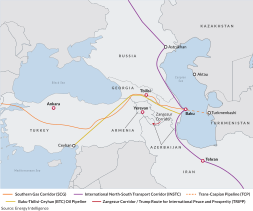
The centerpiece of the US-brokered deal is a 99-year lease along a 20 mile corridor connecting Azerbaijan to Nakhchivan, an exclave that borders Turkey and is separated from Azerbaijan by Armenian territory. The so-called Zangezur Corridor, rebranded the Tripp, could eventually include rail lines, communication networks and oil and gas pipelines through southern Armenia along the border with Iran, the White House says.
Details of the corridor project are still being hashed out but involve a US-led consortium gaining exclusive development rights in an Armenian strip of land while providing Azerbaijan with a transit route to its Nakhchivan exclave and linking it directly with Turkey. The White House said Tripp would facilitate greater exports of energy and other resources. Some analysts question the commercial viability of a major new project given existing trade and energy routes through Georgia, including the Baku-Tbilisi-Ceyhan oil pipeline.
Political Hurdles
A final peace agreement still faces significant political hurdles but could set the stage for advancing key transportation corridors. Tripp is viewed as a part of a constellation of transport links and pipeline dreams, dubbed the Middle Corridor, that stretches from China through Central Asia to the Caucasus via the Caspian Sea and on to Europe, avoiding the risky territories of Russia and Iran. Expanding and deepening the Caspian-Europe corridor threatens to stymie Russia’s efforts to develop its own International North-South Transport Corridor running from the Baltic Sea to Iran and beyond, some Russian analysts say. A memorandum of understanding signed by Socar and Exxon Mobil, which has for years been seeking to exit Azerbaijan’s upstream, anchors the US supermajor as a key player in Washington’s new commitment to the region’s economic future but is also seen in Russia as helping create this new corridor to Europe.
Turkey expert Nigar Goksel, with the International Crisis Group think tank, argues that the planned US involvement in an east-west route doesn’t entirely preclude a north-south corridor for Russia and Iran. However, despite the Kremlin cautiously welcoming the tentative US-brokered peace deal, Russian analysts view the Tripp agreement as a big blow to Russia’s interests and influence in the region. “The fact that this does not bode well for Russia is undeniable,” but more important is the wider impact of the geopolitical changes in the South Caucasus, said Fyodor Lukyanov, research director of Russia’s Valdai International Discussion Club. It would be delusional to think there would be no impact in the North Caucasus, he added.
Robert Cekuta, a former US ambassador to Azerbaijan, said that eventually supplying Azeri oil and gas into Armenia would provide Yerevan with alternatives to Russia’s stranglehold over Armenia’s energy supply. But what would really transform the region is the long-dreamed-of Trans-Caspian pipeline, bringing Turkmenistan’s gas to Europe via Azerbaijan. “The energy implications are going to really come down to not so much Azerbaijan per se, but what can be done further east,” he said. Trump’s move is a visible step-up in US engagement in the closely intertwined South Caucasus and Central Asia regions, Cekuta added.
SOUTH CAUCASUS PIPELINES AND PLANNED TRANSPORT CORRIDORS
Complex Regional Dynamics
From a geopolitical viewpoint, the US foray into the South Caucasus challenges the influence of Russia and Iran at a time when both countries have been weakened. “Russia and Iran have serious strategic limitations now for reasons having to do with events in other geopolitical theaters or adjacent geopolitical theaters,” Damjan Miskovic, a professor at ADA University in Baku, said on a panel hosted by the Hudson Institute, a Washington think tank. “But that doesn’t mean that they’re not going to have some kind of a reaction to this, especially if it takes off.”
Armenia felt abandoned by Russia, its traditional ally, when Azerbaijan, backed by Turkey and Israel, retook large parts of Armenian-controlled Nagorno-Karabakh in 2020 and then in 2023 seized full control and expelled more than 100,000 ethnic Armenians. Regional developments have strengthened Turkey’s position thanks to its alliance with Azerbaijan. Lasting peace between Azerbaijan and Armenia could, in turn, lead to normalization between Armenia and Turkey. These regional dynamics are unfolding against a backdrop of deteriorating ties between Azerbaijan and Russia, with implications for the energy sector. Russia bombed Azeri oil and gas facilities in Ukraine on the same day that Aliyev was at the White House, pointing to future risks.
Deeper US involvement in the South Caucasus is unwelcome news for Iran, too, following a series of blows to its Middle East policy and the 12-day conflict with Israel as well as the US bombing of Tehran’s nuclear facilities in June. Iran is concerned not only by the prospect of a US-controlled corridor on its border but also an ascendant Turkey-Azerbaijan alliance as well as Baku’s close security ties with Israel. In one sign that Azerbaijan is supplanting Iran in the broader region, it is working with Turkey to supply Syria with gas.
Iran’s foreign ministry welcomed the prospect of peace between its neighbors but said the Tripp corridor must not cut off Iran. Ali Akbar Velayati, a top adviser to Iran’s supreme leader, called the corridor a plot against Iran, not a trade route, warning that it would become a “a graveyard for Trump’s mercenaries” and insisting that Iran would move to block it “with or without Russia.”
“The US presence could deter some direct aggression, but it will also paint the corridor as a target in the hybrid-warfare playbooks of both Moscow and Tehran,” said Mehmet Ogutcu, a former Turkish diplomat and head of the London Energy Club.
Chase Winter is a US foreign policy reporter for Energy Intelligence based in Washington. A version of this article appeared originally in Energy Compass.